Apple Macbook Air 2013 Max Download and Upload Speeds
Real Earth 802.11ac Performance Nether OS 10
A good friend of mine recently bought an older house and had been contemplating running a bunch of Cat6 through the crawlspace in order to get good, high-speed connectivity through his habitation. Pretty stoked nigh what I institute with 802.11ac operation on the MacBook Air, I idea I came across a much easier solution to his trouble. I shared my iPerf data with him, but he responded with a totally valid request: was I seeing those transfer rates in real globe file copies?
I have an iMac running Mountain Lion continued over Gigabit Ethernet to my network. I mounted an AFP share on the MacBook Air connected over 802.11ac and copied a film over.
21.2MB/s or 169.6Mbps is the fastest I saw.
Hmm. I connected the iMac to the same ASUS RT-AC66U router equally the MacBook Air. However 21.2MB/s.
I disabled all other wireless in my function. Still, no difference. I switched ethernet cables, I tried different Macs, I tried copying from a PC, I fifty-fifty tried copying smaller files - none of these changes did anything. At most, I only saw 21.2MB/s over 802.11ac.
I double checked my iPerf data. 533Mbps. Something weird was going on.
I plugged in Apple'due south Thunderbolt Gigabit Ethernet adaptor and saw 906Mbps, clearly the source and the MacBook Air were both capable of high speed transfers.
What I tried next gave me some insight into what was going on. I setup web and FTP servers on the MacBook Air and transferred files that way. I didn't get 533Mbps, but I broke 300Mbps. For some reason, copying over AFP or SMB shares was limited to much lower performance. This was a protocol issue.
Digging Deeper, Finding the Culprit
A major component of TCP networking, and what guarantees reliable data transmission, is the fact that all transfers are acknowledged and retransmitted if necessary. How frequently transfers are acknowledged has big implications on operation. Acknowledge (ACK) too ofttimes and you'll become terrible throughput as the sender has to cease all work and wait for however long an ACK takes to travel across the network. Acknowledge too rarely on the other hand and you lot run the risk of doing a lot of wasted piece of work in sub optimal network weather. The TCP window size is a variable that'southward used to ascertain this residue.
TCP window size defines the max amount of data that can exist in flight before an acknowledgement has to exist sent/received. Modernistic TCP implementations back up dynamic scaling of the TCP window in order to optimize for higher bandwidth interfaces.
If you know the round trip latency of a network, TCP window size as well equally the maximum bandwidth that can be delivered over the connectedness you tin actually calculate maximum usable bandwidth on the network.
The ratio of the network'due south bandwidth-filibuster production to the TCP window size gives us that max bandwidth number.
The 2-stream 802.11ac in the new MacBook Air supports link rates of up to 867Mbps. My iPerf data showed ~533Mbps of usable bandwidth in the best conditions. Round trip latency over 50 ping requests betwixt the MBA customer and an iMac wired over Gigabit Ethernet host averaged 2.8ms. The bandwidth-delay product is 533Mbps x 2.8ms or 186,550 bytes. At present let's await at the maximum usable bandwidth as a part of TCP window size:
| Impact of TCP Window Size on 802.11ac Transfer Rates, 533Mbps Link, 2.8ms Latency | ||||||||
| Window Size | Bandwidth-Delay Production | TCP Window/BDP | Percentage | Link Bandwidth | Max Realized Bandwidth | |||
| 32KB | 186550B | 32768/186550B | 17.6% | 533Mbps | 93.6Mbps | |||
| 64KB | 186550B | 65536/186550B | 31.1% | 533Mbps | 187.2Mbps | |||
| 128KB | 186550B | 131072/186550B | 70.iii% | 533Mbps | 374.5Mbps | |||
| 256KB | 186550B | 262144/186550B | 140.5% | 533Mbps | 533Mbps | |||
The only way to become the full 533Mbps is past using a TCP window size that's at least 256KB.
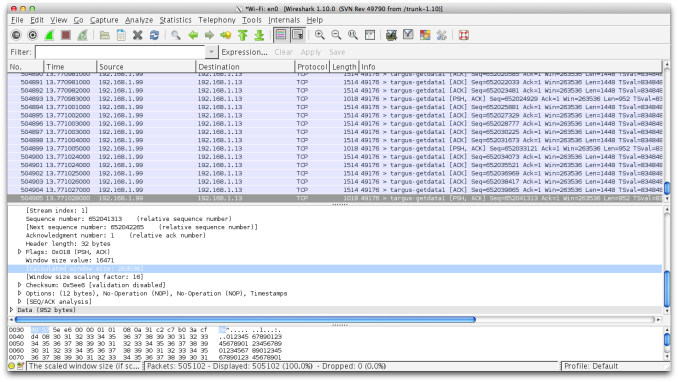
I re-ran my iPerf test and sniffed the packets that went by to confirm the TCP window size during the test. The results came back as expected. Bone X properly scaled up the TCP window to 256KB, which enabled me to get the 533Mbps result:
I then monitored packets going by while copying files over an AFP share and found my culprit:
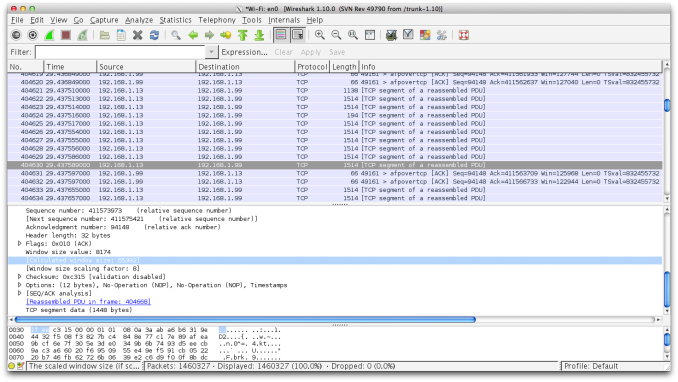
OS X didn't scale the TCP window size beyond 64KB, which limits performance to a bit higher up what I could get over 5GHz 802.11n on the MacBook Air. Interestingly plenty you can get better operation over HTTP or FTP, but in none of the cases would Os X scale TCP window size to 256KB - thus artificially limiting 802.11ac.
I spent a proficient amount of fourth dimension trying to work around this issue, even manually setting TCP window size in OS X, but came up empty handed. I'chiliad not overly familiar with the networking stack in OS 10 and then it's very possible that I missed something, but I'one thousand confident in saying that in that location's an issue here. At a risk of oversimplifying, information technology looks like the TCP window scaling algorithm features a difficult limit in Bone X's WiFi networking stack optimized for 802.11n and unaware of air conditioning's higher bandwidth capabilities. I should also add that the current developer preview of OS Ten Mavericks doesn't set up the issue, nor does using an Apple 802.11ac router.
The bad news is that in its aircraft configuration, the new MacBook Air is capable of some amazing transfer rates over 802.11ac but you won't encounter them when copying files between Macs or PCs. The practiced news is the issue seems entirely confined to software. I've already passed along my findings to Apple. If I had to guess, I would expect that we'll meet a software update addressing this.
802.11ac: 533Mbps Over WiFi Display
kollmansqualleave.blogspot.com
Source: https://www.anandtech.com/show/7085/the-2013-macbook-air-review-13inch/10
0 Response to "Apple Macbook Air 2013 Max Download and Upload Speeds"
Post a Comment