When You Boot Windows From Cd When It Restarts Do You Boot From Cd Again
For Windows PCs that won't start upwardly, can't boot, or cannot become past the login screen, one of the only repair venues left is starting up the PC from a bootable CD, DVD, or USB.
Contents
- 1 Bootable CDs
- ane.1 Not all CDs are created equal!
- 2 Configuring your PC to Boot from CD
- two.ane Via the Kick Selection Menu
- 2.2 Accessing the Kicking Selection Menu
- 2.ii.i Using the Boot Selection Carte
- two.3 Via "Kick Priority" in the BIOS Setup
- two.3.one Inbound BIOS Setup
- 2.3.2 Changing the Primary Kick Device
- 3 Unable to kicking from CD?
Bootable CDs
Depending on your computer'south make and model, there are two dissimilar ways of telling your PC to showtime from the CD or DVD. In all cases, you will demand to insert the CD or DVD into your reckoner's optical bay, and fully power-down your machine. It's of import that you start from a computer that is completely switched off.
Not all CDs are created equal!
The outset and foremost requirement for booting from a CD or DVD is to have a valid, bootable CD or DVD on manus. Bootable discs are very unlike from normal software that ships on a CD or DVD. The normal method of creating a CD by copying or burning files on to a blank CD-R or DVD±R is insufficient to create a bootable CD. Instead, if you did not obtain a physical copy of the bootable CD or DVD from a store or in the mail, you will probable demand to convert an ISO file into a bootable CD or DVD by burning anISO prototype of the data on to the disc, instead of the data itself. Earlier continuing with this guide, brand sure you have correctly followed the instructions on properly creating a bootable CD or DVD.
Configuring your PC to Kick from CD
Via the Boot Selection Bill of fare
Most laptops and desktops built in the past few years accept a special key that tin be pressed immediately later pressing your PCs power push that will let you choose a device to boot from. Pressing this button will bring upwardly what is termed as a "kick choice menu," showing a list of all storage devices currently attached to your PC, and giving you the choice of selecting a device other than your local hard disk to boot from,this one fourth dimension. The selection is temporary: whatever you select, your PC will attempt to boot from it. However, on subsequent (re)boots, your PC will employ the original default startup choice (typically a local difficult disk).This is the preferred method of starting up your PC from a CD or DVD.
Accessing the Kick Selection Card
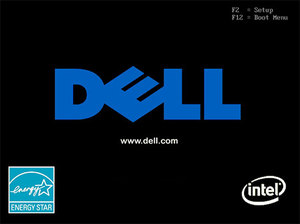
Detect the key guide in the top-right corner.
Immediately subsequently powering up your PC, equally soon as the manufacturer logo (e.g. Dell, Lenovo, HP, Toshiba, Samsung, ASUS, Acer, Gateway, etc.) shows up on your BIOS splash screen, yous will have the option of pressing a special primal.This central changes from PC to PC, it all depends on your PC's brand and model.
Typically, y'all will run across a brief annotation at the bottom or superlative of the screen indicating what the key is. One such screen is visible to the right, note the legend in the acme-right corner indicating F2 will start the BIOS setup and F12 will nowadays the kick selection menu.
Some common options include the F2, F8, F12, and Del keys. All the same, it could exist whatever of the i hundred other keys on your keyboard.
Using the Boot Selection Menu
Subsequently pressing this special key, a menu similar the one shown below will appear:
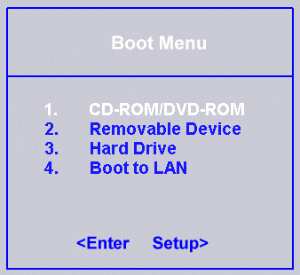
Boot Selection Menu
Choosing "CD-ROM/DVD-ROM" from this card will brainstorm the kicking procedure from your CD or DVD drive.
Via "Kicking Priority" in the BIOS Setup
For older PCs or some of the new "user-friendly" laptops and notebooks, at that place may not exist an choice to cull a one-time kick device via an F-key. For these PCs, it may be required to change the default boot device in the BIOS setup.
Entering BIOS Setup
Again, following the aforementioned instructions as above, fully ability down the PC y'all intend to boot from the CD or DVD. Upon powering up the device, you might meet a legend indicating which cardinal volition enter BIOS setup. In the screenshot above taken from a Dell PC, the F2 button will enter setup. Some mutual options include the Esc, F1, F2, F8, F12, Del, Enter, and Infinite keys.
Changing the Primary Boot Device
The verbal instructions volition again vary depending on your PC's make and model, just all PCs have an option in the BIOS to change the boot device. Unlike the kicking selection card in the previous section,this choice is "sticky" and will need to be changed back once y'all're done with booting from the CD or DVD.
Here are some screenshots of some of the more popular BIOS configurations:
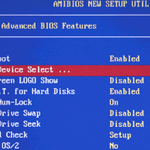
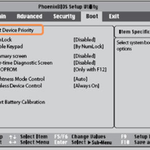
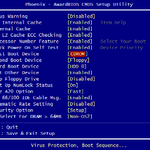
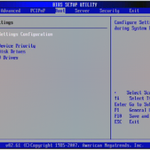
As you can encounter, the exact names and labels differ greatly from one device to the next. You will need to access the section called something along the lines of "boot device" or "kick priority" and and then alter the beginning boot device from "hd" or "local disk" or "hard drive" to "CD-ROM" or "DVD-ROM." Irresolute the lodge of boot devices tin be a little catchy, again depending on the BIOS in your estimator the keys may vary, but unremarkably using either the + and - keys or the↑ and↓ arrows on your keyboard volition move the highlighted kicking option up or downwardly in the BIOS setup card.
After correctly giving priority to the CD/DVD over the local hard deejay, yous will need to save changes and go out. Over again, the exact steps depend on your PCs brand and model, but more often than not navigating with the← and→ arrow keys will let you accomplish the options of "discard changes and exit" vs "save changes and exit," amid others. It's important that you lot cull the "salvage changes and get out" selection! The keyboard shortcut F10 is oftentimes synonymous with "relieve and exit" but yous should make sure earlier using it.
Your PC will so exit the BIOS setup utility and reboot. Upon rebooting, it volition attempt to kicking from the media in your CD/DVD bay.
Running Windows eight or using a UEFI PC/laptop?
Newer Windows PCs and laptops use something called UEFI/EFI that tin can interfere with booting from recovery CDs and USBs. Yous may need to follow the additional instructions on enabling Legacy Boot and disabling Secure Boot to make sure your PC or laptop is configured to support booting from recovery CDs, DVDs, and USB sticks, especially if you can't go it to work after following the steps above.
Call back to alter the selection dorsum!
If you had to change the device priority in your BIOS, yous volition need to remember to change it back once you're done with the recovery/installation disc. Otherwise, your PC will always boot from the CD/DVD bulldoze if there's annihilation in it — and merely if in that location is no bootable CD inside will it actually try booting from your local disk!
Unable to boot from CD?
If you lot're unable to kick from the CD or DVD, please refer to the defended article in our knowledgebase on troubleshooting problems booting from CD or DVD. The possible troubleshooting steps are besides numerous to include here.
Advise an edit
kollmansqualleave.blogspot.com
Source: https://neosmart.net/wiki/booting-from-a-cd-or-dvd/
0 Response to "When You Boot Windows From Cd When It Restarts Do You Boot From Cd Again"
Post a Comment